Opinion: Western Canada joins moon mission through lunar vehicle program
By Scott Brass, Calgary Herald
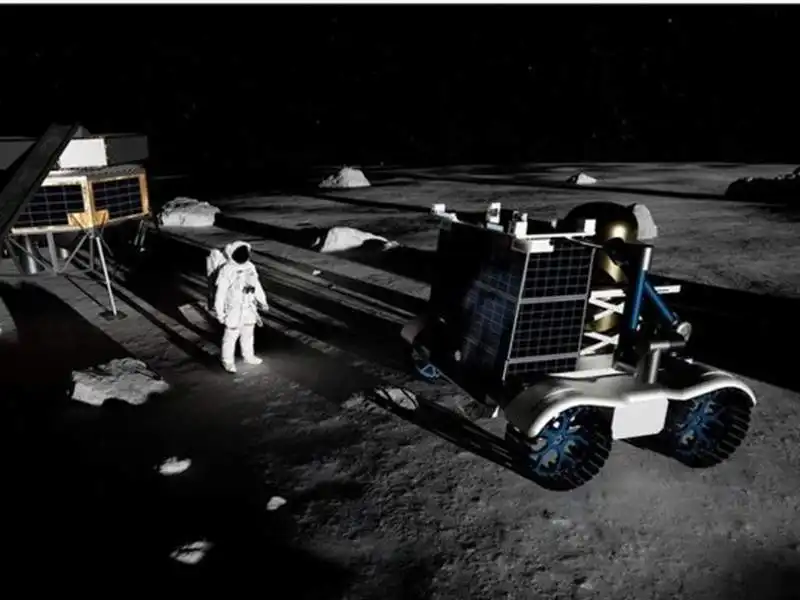
Canada is contributing several key technologies to NASA’s Artemis program, which aims to return humans to the moon for the first time in more than half a century. One of the newest elements of Canada’s contribution is the Lunar Utility Vehicle (LUV), a Canadian-designed mobility platform that will support future human and robotic activities on the lunar surface.
While most Canadians associate space development with major centres in Ontario and Quebec, recent work is showing that Canada’s lunar program is becoming more geographically diverse. In November, Mission Control Space Services announced its first partner for the LUV development effort — Eagle Flight Network (EFN), an Indigenous-owned space-infrastructure company based in Calgary.
EFN is the only western Canadian organization named as a collaborator in the early development work for the LUV.
The LUV program is part of the Canadian Space Agency’s investments under the Lunar Exploration Accelerator Program (LEAP), which supports research, technology development, mobility systems and mission concepts that will contribute to the Artemis lunar missions. In July 2025, Mission Control was awarded a contract to advance aspects of the LUV’s development, including assessing its mobility, mission profile and technical options depending on size and capability.
The LUV is envisioned as a multi-purpose platform that can support astronauts during surface operations, transport equipment, carry instruments and assist missions operating in the demanding environment of the lunar south pole.
Conditions at the pole are far more challenging than previous lunar landing sites — sunlight arrives at low angles, temperatures vary widely and the terrain includes crater rims, shadowed regions and steep slopes. Designing a vehicle that can function reliably requires significant engineering and testing on Earth before any mission hardware is built.
EFN’s involvement is focused on ground-segment considerations — how mission data is received on Earth, how it is routed securely across Canada and how future mission support infrastructure might be positioned. EFN has been developing Indigenous-hosted ground station sites and mobile ground station systems for Earth observation, wildfire detection and satellite communications.
Applying that experience to a lunar mission represents a new area of work for the company, and an example of how Canada’s emerging space sector is widening beyond its traditional players.
For Alberta and Western Canada, participation in the LUV effort marks an important milestone. Historically, national space programs have been concentrated in regions with established aerospace clusters. The inclusion of a Treaty 7-based company in early lunar development signals a shift — space work is becoming more distributed.
It also reflects the growing role of Indigenous-led organizations in Canada’s technology landscape, particularly in areas such as satellite operations, ground infrastructure and remote sensing.
The Artemis program is an ambitious, multi-year effort involving dozens of countries. Canada’s contributions include the Canadarm3 robotic system, lunar science instruments and mobility systems such as the LUV. These technologies will support surface exploration, future habitats and the long-term goal of establishing a sustained human presence on the moon.
Over time, Canadian-built systems are expected to play a significant role in both scientific operations and international collaboration on the lunar surface.
Although the LUV project remains in its design and assessment phase, the work performed now will guide the decisions that determine its final configuration and capabilities. Each of these early efforts — from mobility studies to mission concepts and operations planning — form part of Canada’s long-term participation in Artemis.
For many Canadians, the idea of returning to the moon feels distant, but contributions to that future are being made today in places such as Calgary and Tsuut’ina Nation. EFN’s involvement in the LUV program highlights the growing reach of Canada’s space sector and the increasingly diverse set of organizations contributing to national missions.
As Artemis advances and the world prepares for humans to walk on the moon again, Western Canada now has a defined role in the work leading up to that milestone.