The Gulf Is About More Than Oil. The Iran War Is Proving It. | Opinion
By Jason D. Greenblatt
President Trump is clear: Long-standing threats like the one emanating from the Iranian regime cannot be managed indefinitely. At some point, they must be confronted directly.
That moment has arrived.
The region is under attack. Missiles and drones are targeting infrastructure, economies, and civilian life.
But this is not a story of a region breaking.
It is a story of a region proving the resilience of what it has built.
Because what is being tested right now is not just security. It is the economic and strategic model the Gulf has spent years, and in some cases decades, building. And under pressure, it is holding up remarkably well.
Across the United Arab Emirates, Saudi Arabia, and Qatar, different paths, sometimes overlapping, have led to a shared direction. Each has invested heavily in building economies that are open, globally connected, and less dependent on a single source of revenue.
The UAE has spent decades establishing itself as a diversified global hub. Saudi Arabia is advancing a sweeping transformation through Vision 2030. Qatar has strengthened its position as a major energy, aviation, and logistics center. All three have significantly expanded their global reach.
Different timelines. Different focus. Same direction.
And that direction is now being targeted.
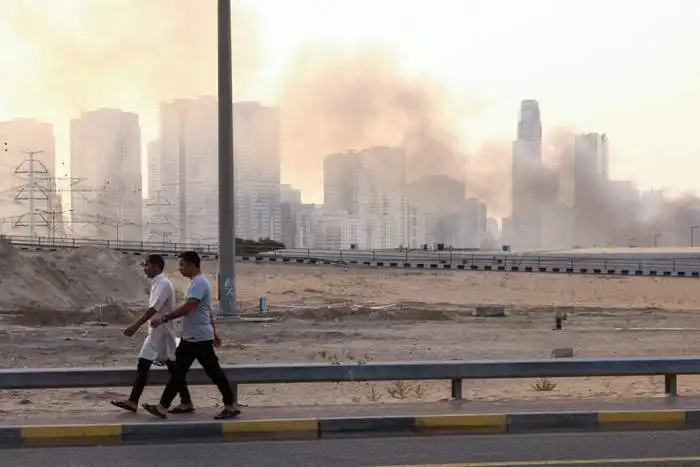
The Iranian regime’s attacks have struck airports, ports, energy infrastructure, and civilian areas. These are not peripheral sites. They are central to how the Gulf connects to the world, and how the world connects through it. Trade routes, logistics hubs, financial centers, energy networks, and airports that serve as global transit hubs, moving tens of millions of passengers between continents each year.
The disruption is real, and at times significant.
Airlines have rerouted and canceled flights. Some airport and energy operations have been temporarily reduced or halted. Shipping and logistics have adjusted in response to heightened risks, including instability around the Strait of Hormuz. Businesses have activated contingency plans, shifted personnel, and adapted supply chains in real time.
But disruption is not breakdown.
Air defense systems have intercepted the overwhelming majority of incoming threats. Core financial systems remain stable. Trade continues to move, even with delays. Companies are not exiting. They are adapting and continuing to operate.
The system is under pressure, and it is performing.
That is not by chance. It reflects how these countries were built.
Diversification has created multiple engines of growth. Financial reserves provide stability. Infrastructure has been built for scale and continuity. Leadership has consistently prioritized execution, speed, and long-term planning.
Those choices are now being validated.
There is also a human dimension that is often missed from the outside.
Speak with people across the region, Emiratis, Saudis, Qataris, and expatriates who live and work there, and a consistent sentiment emerges.
There is confidence.
Confidence in leadership. Confidence in direction. Confidence that this period will pass.
A large majority of residents have stayed, continuing their work and daily lives through uncertainty because they believe in where these countries are going and how their leadership is managing this moment. While some have left for understandable reasons, many will return for the same reasons they came: opportunity, stability, and growth. Those fundamentals remain intact.
That matters—because capital and talent are drawn to places that manage risk, create opportunity, take care of their people, and continue to function under pressure.
That is what the Gulf is demonstrating.
Investors, companies, and institutions are watching closely. What they are seeing is not collapse. They are seeing systems that absorb pressure and continue to operate. That builds confidence.
There is also a broader strategic context.
The region’s trajectory will not be defined by this moment alone.
It will be defined by what has been built, and what continues to be built.
These economies are evolving, investing, and expanding even amid uncertainty. Their ambition to serve as global hubs, attract talent and tourism, host major global events, and lead across energy, aviation, finance, and technology remains unchanged.
If anything, it has been reinforced.
And when this period passes, the story will not be about what was disrupted. It will be about what endured, and the momentum that continued despite it.
The UAE, Saudi Arabia, and Qatar will continue to deepen their roles as global hubs and expand their reach across the global economy.
They will move forward.
And they will move faster.
Because resilience proven under fire does not just preserve confidence. It multiplies it.
What the Gulf has built is not fragile.
It is built to win.
And when this period passes, the Gulf will not simply return to where it was.
It will rise stronger, more confident, and more central to the global economy than ever.
Source: https://www.newsweek.com/the-gulf-is-about-more-than-oil-the-iran-war-is-proving-it-opinion-11713691