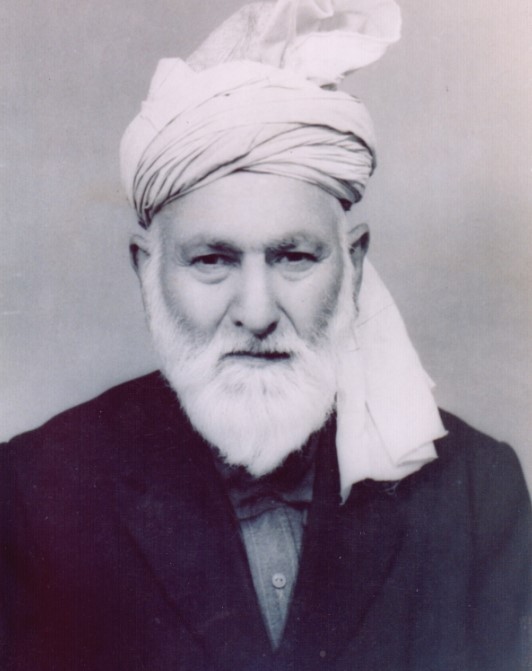
Hazrat Qazi Muhammad Yousuf Farooqira
By Dr Masood Ahmad Qazi Chicago Northwest
My father, Hazrat Qazi Muhammad Yousuf Sahibra was an eminent companion (Sahabi) of Hazrat Masih-e-Maudas. He accepted Ahmadiyyat at the age of 18 (January 1902) while he was in high school in Peshawar (formerly NWFP). He then traveled to Qadian to have the honor of performing Bai’at at the blessed hand of Hazrat Mirza Ghulam Ahmadas. This was a momentous and revolutionary experience for Hazrat Qazi Sahibra, who subsequently devoted his whole life to the service of Ahmadiyyat and Islam, and became a valiant and illustrious “mujahid,” ready to sacrifice everything for Ahmadiyyat. He has been rightly called the “Father of Ahmadiyyat” in the (formerly) Northwest Frontier Province of Pakistan (now KPK).
He faced ferocious and vicious opposition in an area inhabited by some of the most ruthless, implacable, and unforgiving people. Hazrat Qazi Muhammad Yousaf Sahibra remained undaunted, traveled widely among the fierce Pathans, debated with their religious leaders, and won their hearts with his humility, sincerity, integrity and moral excellence.
He was an intrepid and tireless Mubaligh, a renowned scholar, and a distinguished, published writer of Pashto, Urdu and Persian poetry. He was truly a great administrator, Amir of NWFP for almost 50 years, and he wrote more than 100 books and pamphlets in Pashto, Urdu and Persian. He built several Ahmadi mosques, gave lectures and dars-e-Qur’an, participated in religious debates, and was able to convert hundreds of noble souls to Ahmadiyyat. His impressive and august personality, immense knowledge, immaculate manners and character, gracious hospitality, personal piety, taqwa and special relation with Allah Taala (Taaluq-Billah) became legendary and a grand testimony to the truthfulness of Hazrat Masih-e-Maudas.
I can also bear testimony that just like Hazrat Masih-e-Maudas was a perfect reflection (“zil”) of the magnificent seerat and life of his Lord and Master, Hazrat Muhammad Mustafasa, similarly, my father (like many Ashab-e-Ahmad) was a true reflection of the life and character of Hazrat Mirza Ghulam Ahmadas.
One special attribute of Hazrat Qazi Sahibra was his sense of honor (“ghairat”) for Islam, Ahmadiyyat, and for Hazrat Mirza Ghulam Ahmadas and his blessed Khulafa. I remember the anti-Ahmadiyya campaign of terror in 1953 when the Punjab exploded in a fury of violence, plunder, mayhem, deadly attacks on Ahmadis, and their mosques and property. This venomous campaign of hatred and bloodshed then spilled over to other regions of Pakistan, spearheaded by the recreant mullahs.
My father, as Amir of the NWFP, worked tirelessly day and night, at every level, to ensure the safety of the Ahmadiyya Jamaat. At the same time, he made sure that the villainous miscreants knew that the brave Ahmadis of the NWFP were not intimidated. He would fearlessly go to the Anti-Ahmadiyya rallies and unruly mob-gatherings, to learn of their nefarious plans while also ensuring that Ahmadis were ready and able to defend themselves.
One day, some rogue youngsters came to our doors and loudly proclaimed, “O Qadianis, how long will you escape our wrath?” They then ran away. My father then took his shotgun, opened the large gate of our house, sat in his chair all day with the shotgun prominently positioned in front of him on the table and continued his study and writing in full view of the public. Our house in Mardan was on an elevated lot and could be seen clearly from a distance. In front of the house was heavy traffic on the road and beyond the road were fields, with tall crops of sugar canes, corn, etcetera. Anybody could have easily targeted him from the road or the fields but he wanted to show that Ahmadis are not cowards and are ever ready to offer the supreme sacrifice.
By Allah Taala’s special grace and the earnest prayers of Hazrat Musleh Maudra and all Ahmadis, a miracle happened in the Punjab. Martial law was imposed and the campaign of terror was crushed, its leaders arrested and indicted. The Ahmadiyya Jamaat in (the former) NWFP by and large, remained safe and sound (Alhumdullilah).
It was such unflinching courage that earned him the respect and admiration of friends and foes alike, in a fierce and tumultuous region of the world. Hazrat Khalifatul Masih IVra in his letters to me referred to Hazrat Qazi Sahibra “an embodiment of Tabligh, an unsheathed sword of Ahmadiyyat (‘nangi talwar’) and a “lion of Sarhad (NWFP) in whose presence the enemies of Ahmadiyyat would tremble with fear.”
There was another fateful incident in the 1930’s, when a violent storm of anti-Ahmadiyya hostility exploded in NWFP, my father was targeted for assassination. In the well-known Qissa Khani Bazaar in Peshawar, a man called Abdul Aziz, a hired gun, tried to kill him by shooting him from behind. The bullet, however, miraculously got stuck in the barrel of the gun. The would-be assassin could neither fire the gun nor eject the bullet. My father was able to quickly overpower him, and pinned him down until the police arrived and arrested him. He was imprisoned for seven years. Allah Taala protected Hazrat Qazi Sahibra according to His promise that “Allah will protect you from the harmful designs of people.” The revelation of Hazrat Mirza Ghulam Ahmadas, “Do not frighten us with fire; fire is our servant; rather, a servant of our servants,” was also fulfilled.
Hazrat Qazi Muhammad Yusaf Sahibas was protected miraculously on many occasions from enemies, from robbers, snakes, accidents and epidemics. He refused to be vaccinated against the plague, small pox, tuberculosis, typhoid, and other contagious diseases, invoking Allah Taala’s special protection, trusting in Allah’s promise to all devout Ahmadis as was vouchsafed to the Promised Messiahas – “I will protect all those who are in your house” (innee uhafizo kullo mun fil daar). Hazrat Qazi Muhammad Yusaf Sahibra was indeed protected from all illnesses and contagious diseases, and lived a long and healthy life. He was blessed with true dreams, revelations (ilham), and visions (kashf). His prayers were blessed with Divine acceptance. He was given knowledge of upcoming events. He was the epitome of fana fillah wa fina fil rasul, a man of God, humble, loving, compassionate, generous, and gracious with total trust in God and complete and uncompromising devotion and unswerving loyalty to Ahmadiyyat and Islam.
He lived a saintly, unblemished, and remarkably productive and beneficent life and finally passed away at the age of 80 (83 according to the Islamic calendar), on January, 4, 1963, in the Ahmadiyya Mosque in Mardan, during Friday prayers, while reciting “tashahud.” He was even told about his hour of death in a dream that he narrated to us about a week before his demise. May Allah bestow His choicest blessings on his noble soul and grant him a special status in the loftiest stations of Paradise. Ameen. May Allah enable us all to follow in his footsteps and be the true servants of Islam and Ahmadiyyat. Ameen.