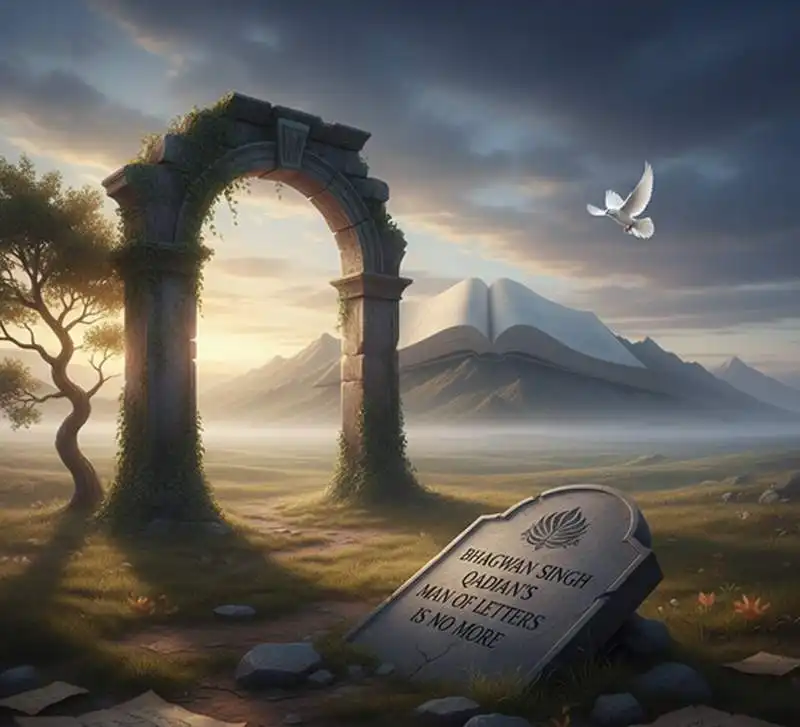
BHAGWAN SINGH QADIAN’S MAN OF LETTERS IS NO MORE
By BILAL AHMAD SHAMIM
Bhagwan Singh of Qadian, District Gurdaspur, a beloved and prolific writer, whose letters adorned and graced the pages of ‘Letters to the Editor’ column of a few widely-read dailies , for almost three decades , passed away on 19th August , 2025 at the age of 94. His letters bore the stamp of his profound knowledge and erudition, and his exceptional command over English. He wrote for the Tribune, Chandigarh , I particular. He was known for embellishing his write-ups with Urdu and Persian couplets with meticulous transliteration followed by their impeccable, immaculate, accurate and excellent English translation.
Born in October, 1931in a well-to-do Jat Sikh family at Datewal Bhindran, District Sialkot (now in Pakistan) , Bhagwan Singh did his Matriculation from Moti Ram Arya High School, Churhamunda in 1946. After Partition, his family moved to the Indian Punjab. During his professional career , he continued his studies earning a graduation degree as a private candidate.
Medium in stature, wheatish rather reddish in complexion, having a round face and lustrous eyes, impeccably dressed and turbaned, Bhagwan Singh possessed worth-emulating qualities of both head and heart. Down-to- earth, unassuming, outright and upright, veracious and virtuous, he never assumed airs of his vast and profound knowledge. A devout Sikh , a strict vegetarian and teetotaller he was.
His passion for Urdu and Persian poetry began in high school and continued throughout his life, turning him into an avid and voracious reader, and ardent lover of both the languages. He could recite couplets from his vast repertoire to fit any occasion, and his scholarly letters helped to ignite a love for Urdu poetry in many readers.
The Tribune, Chandigarh of August 14, 2016 and May 15, 2025 carried write-ups about Bhagwan Singh revealed wherein he revealed that his first letter was published in Tribune on July 20, 1989.
Letter writing is natural for anyone, he observed. He made a point that one cannot reread a phone call. Persian books , a transistor, a whirring table fan, a pen and a pad were his companions in his study
He would often use his writings to correct literary errors, misrepresentations of historical facts, or incorrectly quoted Urdu couplets. .
He never typed his letters and always wrote them neatly in longhand. He was gifted with the felicity of phrase.
He had a mutual friendship with the author of this tribute, who was inspired by him to begin writing letters to the Tribune as well.
He was a regular subscriber to Naya Daur, an Urdu magazine of the Information & Publication Deptt of U.P. During one of our conversations, I got to know that he always got up at four in the morning, listened to Aasa Di Vaar without fail, took a glass hot water mixed with lemon juice, and was very punctual and regular in his morning and evening walks . He seldom watched Television and retired to bed by 10 p.m. ‘Although a teetotaller, albeit I read poetry about wine with zeal and gusto’, he jokingly said.
I would like to present a couple of Urdu and Persian couplets beautifully rendered into English by him.
Har sokhta jaane ke ba Kashmir dar aayad,
Gar murgh kabaab ast, ba baal-o-par aayad.
( Any distressed person who visits Kashmir returns duly endowed with pinions and feathers of health even if is like a roasted chicken.)
Ba tars az aah-mazloomaan ke hungama dua kardan,
Ijabat az dar-e- Haq behr-e- istaqbaal mee aayad.
(Fear the sighs of the wronged people, because when they recite a prayer, its acceptance comes from God’s door to greet it.)
Gar tujh Ko hai yaqeen-e-ijaabat, dua na maang,
Ya’ni baghair-e- yak dil-e-be mudda’a na maang.
(If you are sure of acceptance of your prayer, don’t pray to God for anything other than a desireless heart.)
Jo ik nigaah se karte they khaak ko akseer,
Kahaan gaye woh muallim, woh mehrbaan ustaad.
( Where have gone those kind pedagogues and teachers who transformed dust into elixir with a single look at it.)
This tribute concludes with a couplet by Dr. Allama Iqbal, offered as a befitting homage to a man of letters who will be deeply missed.
Jo baadah kash the puraane , woh uthte jaate hain,
Kaheen se aab-e baqaa-e-dawaam ley Saaqi.
(The veteran wine guzzlers are taking their turn to leave the tavern,
Therefore, O wine-server, bring from somewhere the nectar that would bestow an eternal life.)