Exploring Nandana Fort: Al-Biruni’s Legacy And The Lost Golden Age Of Muslim Science
By Maj Gen Dr Muhammad Masudul Hasan Nuri
Journey to Nandana Fort recalls Al-Biruni’s scientific legacy, the Golden Age of Islam, and a prayer for the revival of Muslim intellectual excellence
Got up early (6:00 am) for my adventurous trip to Nandana Fort in Pind Dadan Khan, Pakistan. I was excited about the visit, Al-Biruni, the 11th-century Persian scholar, who lived and travelled in India, attracted my attention for two reasons: firstly, it is the same place which is believed to be Abu-Rayhan al-Biruni’s observatory where he quantified the radius and circumference of the Earth. Secondly, in the context of Al-Biruni’s treatise, Kitab al-Hind, a crucial historical source, where he noted Jewish presence in Kashmir.
With prayers, we darted off in my bulletproof wagon, accompanied by my guard Saqib and driver Jalal, onto the motorway.
It was a pleasant, somewhat cloudy morning, hot and humid. The drive was enjoyable. On my way, I scrolled through the internet getting information about the great polymath and Nandana Fort. Midway through our journey we stopped by the Monal Restaurant for breakfast. It was a pleasant break and I ordered paratha omelette for all three. I had cappuccino coffee and my colleagues had tea. Soon we sped off to Pind Dadan Khan where Malik Riaz (historian, archaeologist) along with two others greeted us. The onward journey was to Nandana Fort in the Baghawalla village. It is famous for its historical and scientific significance. Here Al-Biruni, an 11th-century Muslim scholar, measured the Earth’s circumference. He utilised trigonometric calculations, measuring the angle of the dip of the horizon from the fort’s hilltop.
The Fort had a rich history, having been ruled by several kings before being conquered by Mahmood of Ghazni.
Nandana Fort’s __cpLocation on the south range made it a crucial defensive position, controlling the routes connecting India and Central Asia. This was the same pass used by Alexander the Great in his epic clash with Raja Porus.
We stopped by the foothills of the Salt Mountains in Pakistan. Abu Rayhan Muhammad ibn Ahmad Al-Biruni, nicknamed Al-Biruni, was born on September 9, 973. He was a great scholar, born in a village on the outskirts of Khwarazm.
Furthermore, he specialised in mathematics, astronomy, history, geography, and medicine.
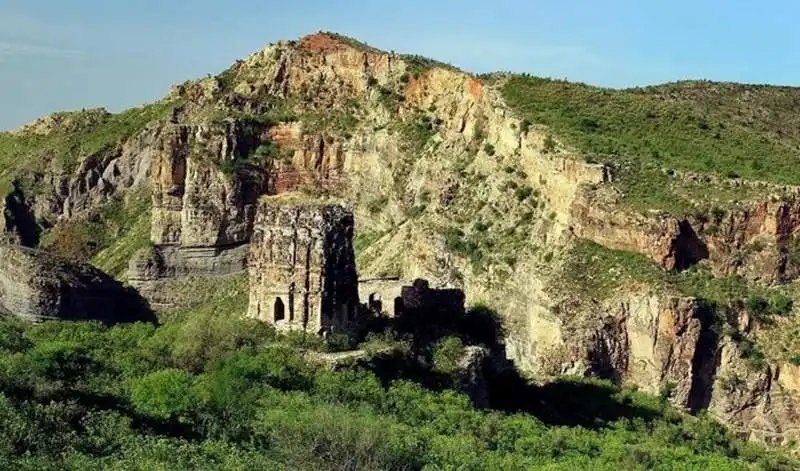
Located in the Jhelum district and surrounded by beautiful mountains, Fort Nandana is a 1,500-year-old hidden gem.
We then moved on a bumpy road near the base of the mountain. Al-Biruni’s observatory was visible.
While tracking my way up to the Nandana Fort, I was overawed by the genius of Al-Biruni when, from this very observatory, he calculated the radius and circumference of the Earth. During his time, countless Muslim scientists, philosophers and intellectuals left an indelible mark on humanity in the cause of human knowledge and understanding. Their pioneering efforts brought about an unremarkable evolution in the world, and their research and discoveries continue to be the basis for modern science. They utilised their God-given talents and faculties, whilst seeking help from Allah the Almighty and reflecting upon His creation, and as a result, have been recognised through history and continue to be acknowledged and reflected today.
Al-Biruni lived here at Nandana Fort for many years, and the rest of India (between 1017-1020). Here, he found the diameter of the Earth very close to today’s value (99%).
Al-Biruni developed many instruments for astronomy and geography measurements. He put forward the first ideas on the theory of gravity, which was mathematically proven by Newton 700 years later. As a result of his observations with the telescope he developed, 600 years before Galileo, who confirmed that the planets revolved around the Sun, Al-Biruni defended the idea that the “Earth rotates”. To the query of why plants and stones don’t shoot up if the Earth is spinning, he answered that there is an attraction at the centre and that everything is in the centre of the Earth’s surface. He predicted that North, South, East and West would connect at a point, and there was a land behind the seas (today’s America).
Al-Biruni died at the age of 75. He inspired scientists such as Copernicus and Galileo, Newton and Torricelli. The UNESCO Courier (1974) introduced Al-Biruni as “the universal genius who lived a thousand years ago in Central Asia.”
According to Al-Biruni, the pleasure of knowledge, that is, the pleasure of teaching for truth and reality, is among the highest pleasures. In this regard, he states: “What is necessary and unavoidable for the men of knowledge, that’s the servant of knowledge, is not to make a distinction between the sciences, even if he is not at a sufficient level in all fields of knowledge, but to give each of them its due. Because knowledge is beautiful and its flavour is permanent. The flavour lasts throughout this research. When the research ends, the flavour ends.”
He continues:
“The scholar should not look down on the scholars who came before him, he should approach their works with modesty and benefit from them. In this way, he will reach the most accurate and solid information and will stay away from flawed and erroneous information.”
While having my tour of Al-Biruni’s Nandana Hill observatory, my thoughts wandered as to how Allah inspired the generations of Muslim inventors in the Middle Ages. As I looked back more than a millennium, I realised how Muslim scientists and inventors played a fundamental role in advancing knowledge and developing technologies, which transformed the world as we see it today.
In my field of medicine, many Muslim physicians and scientists made great discoveries and pioneered many inventions that remain in use today. Many of the surgical instruments were pioneered by Muslim physicians in Al-Zahrawi’s and Al-Biruni.
In the 17th century, an English physician, William Harvey, famously carried out what we consider as groundbreaking research regarding blood circulation and the functioning of the heart. However, it was later discovered that more than 400 years before Harvey’s research, Ibn Nafees, an Arab physician, had already detailed the basics of pulmonary circulation.
In an article published by the National Geographic in 2016, “How Early Islamic Science Advanced Medicine”, the contributions of Muslim scientists in the early period of Islam are identified:
“Physicians from Islamic countries during the late Middle Ages enjoyed great respect. Their reputation was well deserved for the study and practice of medicine was then led by Muslim societies across their immense territory, which extended from modern-day southern Spain to Iran.”
It further states:
“By the 900s, drawing from a growing body of Greek, Persian and Sanskrit works translated into Arabic, Islamic medicine quickly became the most sophisticated in the world. Christians, Jews, Hindus and scholars from many other traditions looked to Arabic as a language of science. Doctors of different faiths worked together, debating and studying with Arabic as the common tongue.”
The article continues:
“The brightest star in the Baghdad firmament was undoubtedly the extraordinary Ibn Sina (a close contemporary of Al-Biruni) … his great volume Al-Qanun fi al-Tibb – Canon of Medicine – became one of the most famous medical works of all time… (Ibn Sina’s) attempts to harmonise the medical practices of the Greek thinker Galen with the philosophy of Aristotle reveal the multiple nature of the debt owed to Muslim scholarship, which did not merely revive Greek authors but stimulated new patterns of thought for centuries ahead. The reconciling of practical science, thought and religion ensured Canon was studied by European medicine until the 18th century.”
Moreover, the National Geographic article labels the period of Muslim rule in Spain as a “period of scholarly development” and describes Cordoba in the 10th century as the “most cultured city in Europe and a great centre of study and exploration”.
As stated by the great reformer: “Continued study of physics, astronomy and the sciences will always lead a righteous person towards the Almighty. The more they learn about God’s creation and the world around them, the more they will appreciate the beauty of Allah the Almighty through the wonder of the universe.”
It was in this way, reflecting upon the universe, that Professor Dr Abdus Salam spent his life and he used whatever insight he gained as evidence to prove the existence of God.
As I descended slowly but carefully from Nandana Hill – the place of Al-Biruni – I lamented: “Although the historic contributions of Muslim scholars like Al-Biruni are unquestionable, the recent intellectual and scientific state of much of the Muslim world is most regrettable.”
Over time, as Muslims moved away from God Almighty and the qualities associated with a believer diminished rapidly amongst them, the Muslims, who had previously led the world in science, medicine, and research, gradually moved to an age of intellectual ignorance that persists to this day. Instead of continuing to be leaders of innovation and discovery, the period of Muslim academic enlightenment drew to an end. Instead of being those who gave to the world, the Muslims became those who only took. As a result, when the world recognises the outstanding historic contribution of Muslims to science and learning, like Al-Biruni, it considers the intellectual status of the modern-day Muslim world to be woeful. The truth is that, generally speaking, the Muslim world has lost its passion for education and for pushing the boundaries of human knowledge. Muslim nations have immersed themselves in the luxuries and comforts of the world and so, they no longer have the drive or motivation to toil in the pursuit of knowledge or to reflect upon the universe.
Thus, in intellectual and scientific terms, Muslims and the Islamic nations have gone from leading the world to being treated with scorn and derision.
As I travelled back to my place, the sun was setting. I leaned back and had a last look at Nandana Fort and prayed with tears in my eyes:
“May Allah the Almighty enable us to flourish, and to achieve great success in our fields of expertise. Working with diligence, passion, and above all, constantly seeking the help of Allah the Almighty at every step of our academic journey and keep His Majesty at the forefront of our minds. Amen.”